
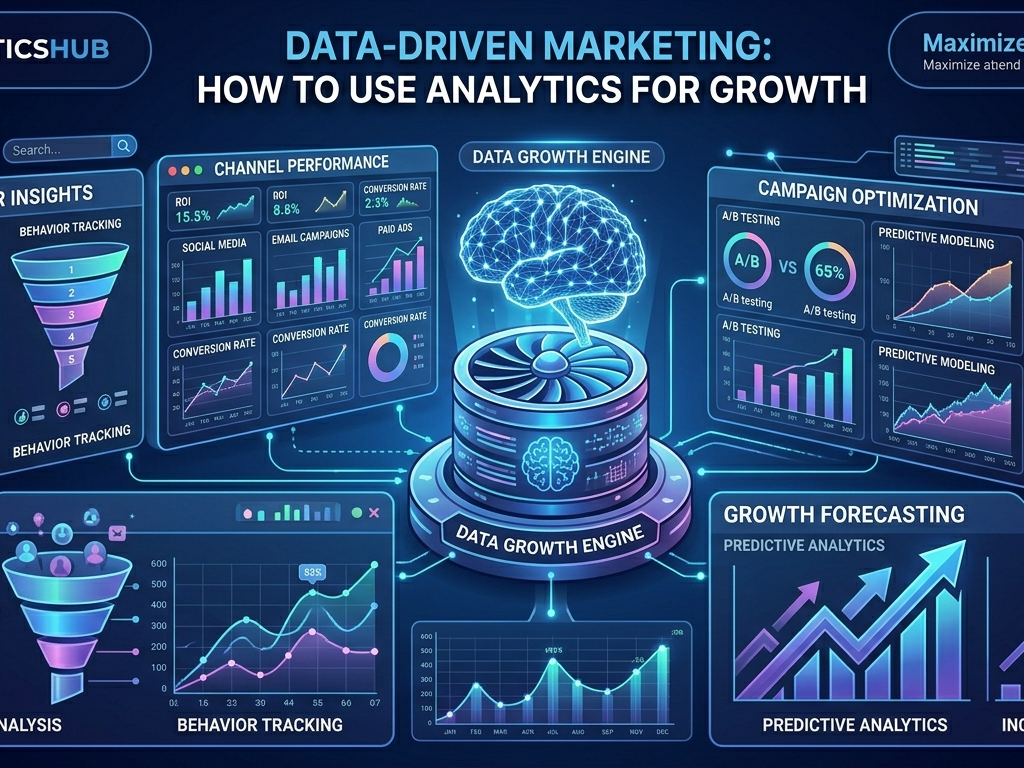
Every business owner has made a marketing decision based on a gut feeling. Sometimes it works. More often, it doesn’t — and the budget spent finding that out is gone for good. Data-driven marketing changes that equation. It replaces guesswork with evidence, and intuition with insight. The result is a marketing engine that doesn’t just spend money — it learns, adapts, and grows.
Here’s how to put analytics to work for your business.
What “Data-Driven Marketing” Actually Means
Data-driven marketing is the practice of using real customer data — behavior, preferences, demographics, purchase history — to guide every marketing decision, from which channels to invest in to what message to put in a subject line.
It doesn’t require a data science team or enterprise software. What it requires is clarity: knowing which numbers matter for your specific goals, and building habits around checking them regularly.
The Metrics That Matter Most
Not all data is useful data. Before you drown in dashboards, identify the metrics directly tied to growth:
Customer Acquisition Cost (CAC) — How much does it cost to acquire one new customer? If you spent $5,000 on ads last month and gained 50 customers, your CAC is $100. Knowing this tells you which channels are efficient and which are draining your budget.
Customer Lifetime Value (CLV) — How much revenue does a typical customer generate over their relationship with your business? When CLV significantly exceeds CAC, you have a healthy, scalable model. When they’re close — or inverted — something needs to change.
Conversion Rate — What percentage of visitors, leads, or prospects actually take the action you want? Low conversion rates often reveal friction in your funnel, not a shortage of traffic.
Return on Ad Spend (ROAS) — For every dollar spent on advertising, how many dollars in revenue come back? ROAS cuts through vanity metrics and tells you whether paid marketing is actually working.
Start with these four. Master them before adding more complexity.
Turning Data Into Decisions: A Practical Framework
Collecting data is the easy part. Turning it into better decisions is where most businesses stall. Here’s a simple framework:
1. Set a clear objective first. Analytics without a goal is noise. Before you look at any report, define what you’re trying to improve — more website leads, higher email open rates, better retention in the first 90 days. Your objective determines which data is relevant.
2. Establish a baseline. You can’t measure improvement without knowing where you started. Capture your current numbers before launching any campaign or making any change.
3. Run one change at a time. A/B testing — showing two versions of an ad, email, or landing page to different audience segments — is one of the most powerful tools in your arsenal. But it only works if you change one variable at a time. Test different headlines, not a different headline and a different image simultaneously.
4. Set a review cadence and stick to it. Weekly reviews for active campaigns, monthly reviews for broader channel strategy. Build it into your schedule. Data that isn’t reviewed regularly is data that isn’t doing anything for you.
5. Act on what you find. This sounds obvious, but it’s where many businesses falter. If the data shows that LinkedIn is generating leads at half the cost of Facebook, shift budget accordingly. Let the numbers overrule the preference.
Add a Comment